
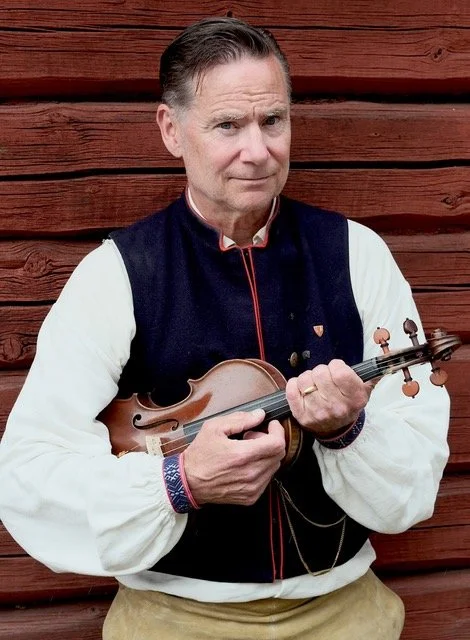
Quite early Anders got Pers Hans as teacher and he also learnt a lot from Pål Olle,
especially many Bingsjö tunes. But it wasn’t until he met Ole Hjorth, a student of
Hjort Anders, that he really discovered the Bingsjö music with its rich and intense
character. Anders started to listen to old recordings with Hjort Anders and
eventually contacted Päkkos Gustaf in Bingsjö and for some period of time they
played quite intensively. After this Anders felt like a Bingsjö fiddler, according to
himself. Apart from his Bingsjö influences, he has played with people from all
around Dalarna and the country, especially from the neighbouring province
Hälsingland. He has also kept a close musical relationship with the Røros fiddlers in
Norway.
I have followed his development ever since the beginning of the 1980s and
sometimes thought that this boy is more wild than tame. Finally, however, he has
summed up his experiences and given these musical expressions on these recordings.
Listen and enjoy.
/ Björn Ståbi, korskrogen
----------------------------------
1. Polska by Hjort Anders 1.
-----------------------------
Pekkos Per Olsson
2. Polska after Pekkos Per 1.
The first two parts after Pekkos Per and the third is by Hjort Anders.
3. The Devil’s Polska, after Pekkos Per.
4. Polska after Pekkos Per 2.
5. Polska after Pekkos Per 3.
6. Polska after Pekkos Per 4.
7. Polska after Pekkos Per 5.
8. “Blårocken”. Polska after Pekkos Per.
9. “Rullpolskan”. Polska after Pekkos Per.
10. “Kringelleken” after Pekkos Per .
11. “Gråtlåten”. Polska after Pekkos Per.
12. Polska after Pekkos Per 6.
13. Polska after Pekkos Per 7.
14. Pekkos Per’s Bridal March.
Olof Måhlén
15. Polska after Pekkos Per 8.
Hjort Anders Olsson
16. Polska after Lapp Nils.
17. Polska after Hjort Anders 1.
18. Slunk Erik’s Polska after Hjort Anders.
19. Blind Palm’s Polska after Hjort Anders.
20. “Lilla Hin”. Polska after Hins Anders.
21. “Knut’s Livstycke”. Polska after Hjort Anders.
22. Polska after Hjort Anders 2.
23. Polska after Hjort Anders 3.
Päckos Olof Hansson
24. Polska after Päckos Olle 1 .
25. Polska after Päckos Olle 2.
“Ritekt Jerk”, Mases Erik Jonsson
26. Polska after Ritekt Jerk 1.
27. Polska after Ritekt Jerk 2.
28. Nu haver denna dag. Choral after Nyåkers Mor
"Nu haver denna dag". Hymn.
Alas, This Sacred Day
Alas, this sacred day,
In God’s merciful hands
Has come to blessed rest.
And resurrected night
Again, for all of us is here
To shed its friendly light.
My clothes of life
My sins alike
Are cleansed in Jesus’ blood.
And thus my frailty
In glory turn, O God
When I’m at last with you.
29. Bort mitt hjärta med de tankar. Choral after Nyåkers Mor
Bort mitt hjärta med de tankar
Bort, mitt hjärta, med de tankar Att Gud ej mer vårdar dig! Hur på stormigt hav du
vankar, Jesus glömmer icke dig. Fastän vågen djupt dig sänker, Och ditt hopp i
mörkret dör, Tänk på vad din Jesus skänker, Hör vad Han i stormen gör.
Hoppas fast på Herren Gud, Gör Hans vilja, håll Hans bud! Han skall dig ur nöden
hjälpa, Ingen storm skall dig omstälpa. Gud är trofast, Gud är god, Fatta, min själ, ett
nytt mod!
När min sista stund omsider Sänker sig i dödens natt, Och min matta blick då glider
Från den jord som jag förlät, O, så låt ditt ljus mig lysa, Jesus, i den mörka dal, Låt
mig ej för döden rysa, För mig till din himlasal.
--
The Finns
The first Finns in Bingsjö belonged to the Loamoinen, Makkoïnen, Tarvoïnen and
Pynninen families. They came to the area at the turn of the 16th and 17th centuries
from Savolax and Tavastland in Finland. The Pekkos family came later from the
Ockelbo Finns and the village Källsjön.
The Music of Finnmark
The folk music of the Finnmark of Rättvik is quite characteristic. One can say that it is
a successful mix of three major influences: The Finnish intensity and austerity, the
melancholy and pride of the Österdalarna and the exhilaration and joy of
Hälsingland, or as Karl Sporr and Karl-Erik Forsslund described this music 100 years
ago, "In Bingsjö the old folk music thrives perhaps even more than it does in Boda
and Rättvik and a great treasure of tunes is to be found here, perhaps larger than in
any other parish in Dalarna. In this place the oldest and most enchanting way of
playing is still used. Wild, intensive with a magic heat; every tone is alive and
vibrant, every finger is like a trembling tongue in a bell with trills from above as from
below the note and with a strong even energetic drive".
The greatest representative of the Bingsjö style in our time was Pekkos Gustaf
(1916–2000). Gustaf had a strong personality, a masterly playing and was a worthy
heir of the Pekkos Per legacy. Gustaf was a farmer, farrier and a blacksmith and
honoured the old customs and traditions. The kitchen at the Pekkos farm has been a
waterhole for many fiddlers over the years and an absolute condition for the survival
of the Bingsjö music, and also a reason for it being stronger than ever today.
Pekkos Per Olsson (1808–1877) is a key figure of the Bingsjö style. He was one of the
great landowners in the village. He was rich and married but had no children. Most
likely, he could spend a lot of time on the tunes and on his playing. Per was a calm
and helpful man and generally appreciated according to Pekkos Gustaf. Per was said
to have spiritual powers and could destroy other fiddlers’ strings with magic. He was
constantly hired “not only as a fiddler but also in all sorts of situations where magic
was needed”.
As a fiddler on weddings he was very sought after both in Hälsingland and the area
around the lake Siljan in Dalarna. There wasn’t a single waltz on his repertoire, only
polskas.
“Ritekt Jerk” Mases Erik Jonsson (1857–1917) came from Finnbacka or “Mäkelä” as
the Finns called it, and he was one of Pekkos Per’s pupils. Much of Pekkos Per’s
music has survived to our days through fiddler friends like Ritekt Jerk who together
with Hjort Anders played many of his tunes. “Ria” was the Finn’s name for a drying
hut for hay or corn. The farm name Ritekt therefore means a drying hut on a
meadow.
Hjort Anders Olsson (1865–1952) is the master fiddler of the Bingsjö style of playing
and he is widely known all over the country. His father was Pös Olle from Finnbacka
who through his marriage came to the farm Långlarsgården in Bingsjö. His son,
Långlars Anders, in his turn took the farm name Hjort when he married Lisbet from
the farm Hjortgården. In his youth Hjort Anders worked as a woodsman and on
sawmills in Orsa Finnmark and in Hälsingland, where the growing sawmill industry
brought along new musical influences. Anders was rewarded many great prizes for
his playing. In 1906 he was rewarded the Zorn medal in gold and the royal medal
”Illis Quorum”. At the Zorn competitions on Sandängarna in Mora in 1908 he won
first prize, a copy of a Stradivarius violin worth 800 kronor at the time. Hjort Anders
left Bingsjö with his family in 1906 and moved to Uppland. He was never to see
Bingsjö again but surely returned many times in his music.
Olof Måhlén (1866–1945) had his roots in the Nedhol family from Backa in Rättvik.
One branch of the family moved to Bingsjö and in that family, five generations later,
Olof Måhlén was born. Måhlén got to hear Pekkos Per as a young boy and it made a
great impression on him. The recorder of folk tunes, Olof Andersson, writes, “During
his adolescence Måhlén frequently played with Hjort Anders and in his way of
playing there are certain similarities between the two”.
In 1906, the same year as Hjort Anders moved from Bingsjö, Olof Måhlén moved to
Tänger in Enviken. To the polska after Olof Måhlén a certain story is told:
“This polska was played by Hin when the Lågasbäck Mill in Bingsjö was destroyed
in the high flood one Midsummer Day. The bridge was also dragged down in the
flood so they put out a foot-bridge. At this very moment Daniels Anders Andersson
fell into the streaming river and he grabbed hold of the foot-bridge. He almost lost
his trousers however, when he was hanging there the stream dragged them down to
his knees.”
(Svenska Låtar)
Päckos Olof Hansson (1869–1952) was a relative of Pekkos Per. According to Päckos
Gustaf he was big and strong, calm but still temperamental. At weddings he never
took more than two drinks. Olle was a cousin to Hjort Anders and together with him
the foremost representative of the Pekkos Per legacy. His playing was soft, rhythmic
and elegant according to Gustaf. Olle’s son, Päckos Helmer Olsson (1905–1985) was
also a master fiddler and an important tradition bearer.
“Nyåkers mor” Anna Persson (1841–1917). True understanding and appreciation of
the kind of important cultural and musical heritage the old hymns represented
unfortunately came quite late. The first recordings in Dalarna were made in 1887. At
this time however many of the songs and hymns had already been lost. The
recordings of “Nyåkers mor” were made by the Dådran priest, Nils Ekblom, in 1911.
-------------------------------------
Recording Details
Recorded mixed and mastered by: Manne von Ahn Öberg at White Chapel Studio,
Jävrebyn, Sweden
Produced by: Manne von Ahn Öberg
Anders Bjernulf
There are many ways in which to express oneself in the Bingsjö musical dialect. I
have always thought that strong energy is needed, both spiritually and physically.
This music demands a great deal, but so does life. To be successful in both, one has to give it all, as fiddler as well as listener.
Anders Bjernulf is now 60 years old. In a fiddler’s perspective he is still very young although he has played for almost 50 years. Anders first got into this music when he as a young boy met and listened to the master fiddlers Pål Olle and Pers Hans. He was then only six years old. The fascination remained however, and he started playing the fiddle at the age of ten.
He was lucky to have musically interested parents. His father, Arne Bjernulf, is very knowledgeable about the fiddle music of Rättvik, the municipality in Dalarna which has seen over a thousand fiddlers over the years.
When he grew up, Anders got to meet many Rättvik fiddlers, some more famous than others and one of these fiddlers that has meant a lot to Anders is Funk Anders (born 1908).